Loading
Inside the hive
TheWonderof Bees
A honeybee colony is one of nature's great marvels — a city of fifty thousand sisters with no boss, building in perfect geometry and turning flowers into the only food that never spoils. Step inside and see how every golden jar really begins.
A city that runs itself
No manager, no blueprint, no orders given. Tens of thousands of bees make decisions together — and somehow the hive always knows what to do next.
The Queen
One mother to them all. She can lay up to 2,000 eggs a day — more than her own body weight — and her scent holds the whole colony together.
The Workers
Tens of thousands of sisters. In six short weeks each one is nurse, builder, guard, undertaker and forager — a new job for every stage of her life.
The Drones
The males, with one purpose: to mate with a queen. They cannot sting and cannot feed themselves — yet the hive raises them every summer all the same.
Nectar to gold
How honey is made
Honey is flower nectar, refined by bees into something that lasts forever. It happens in five quiet steps.
01
Forage
A worker sips nectar from up to 1,500 flowers a trip, storing it in a special honey stomach.
02
Pass it on
Back home she passes it mouth to mouth, where enzymes begin turning nectar sugars into honey.
03
Store
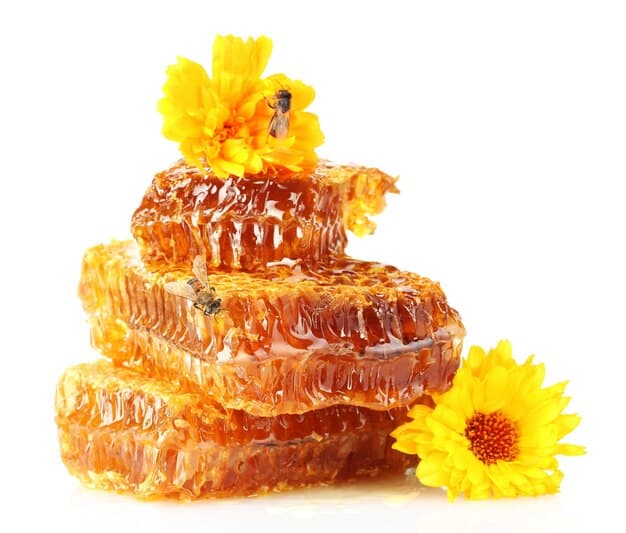
The thickening nectar is tucked into flawless six-sided wax cells, built at a perfect 120° angle.
04
Fan & dry
Thousands of beating wings fan the comb, evaporating water until it is rich, golden and stable.
05
Cap
Each finished cell is sealed with a wax cap — a pantry that can keep for thousands of years.
The bees do all of this. We only carry the jar to you. Taste the result
Hard to believe
Small bee, tall tales
2,000,000
flowers visited to fill a single 500g jar
~200
wingbeats every second — that is the buzz you hear
5
eyes — two large, three tiny — that read the sun and sky
55,000
flight miles behind one jar — over twice around the Earth
They talk by dancing
The waggle dance
When a forager finds a rich patch of flowers, she returns and dances a precise figure-eight on the comb. The angle of her waggle tells the others the direction relative to the sun; the length tells them how far. It is a working map, drawn in movement — a genuine symbolic language, and one of the few known outside of humans.
Why it matters
Quietly feeding the world
Bees are not just honey-makers. As they move from bloom to bloom they pollinate the plants that become much of what we eat. Protecting them is one of the simplest, most far-reaching things we can do.
1 in 3
bites of food depends on pollinators like the honeybee
90+
crops — from almonds to apples — that rely on bees
Forever
the shelf life of pure honey, sealed in wax or a jar